2026-02-26
Applied AI ethics in the workplace
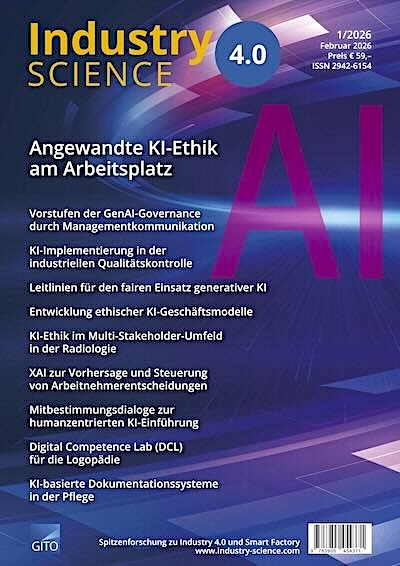
We are represented with three articles in the current special edition of the international journal ‘Industry 4.0 Science’.
"The application of AI ethics in the workplace is everyone’s responsibility. It requires responsibility on the part of companies as a whole and conscious action on the part of a large number of individuals—whether developers or users, managers or employees. This issue of Industry 4.0 Science is dedicated to the interplay of individual responsibility and organizational leadership in a broader social and regulatory context. The topics range from competence development for the ethical use of AI to issues of governance and employee representation. The findings come from various fields, including radiology, speech therapy, assembly, and quality control (Industry 4.0 Science).
 © Industry 4.0 Science
Applied AI ethics in the workplace
We are represented with three articles in the current special edition of the international journal ‘Industry 4.0 Science’.
"The application of AI ethics in the workplace is everyone’s responsibility. It requires responsibility on the part of companies as a whole and conscious action on the part of a large number of individuals—whether developers or users, managers or employees. This issue of Industry 4.0 Science is dedicated to the interplay of individual responsibility and organizational leadership in a broader social and regulatory context. The topics range from competence development for the ethical use of AI to issues of governance and employee representation. The findings come from various fields, including radiology, speech therapy, assembly, and quality control (Industry 4.0 Science).
All contributions are available (with one click) via open access:

Copyright © RUB/IGM 2026
Last update: Mar 03, 2026